

Billy Strings Is Playing So He Never Has to Go Back
The bluegrass star turned poverty, addiction and his mother’s death into music — and is now trying to make sure the trauma of his family ends with him.



Billy Strings walks onto stages in front of tens of thousands of people, yet in the worst moments before a show he can still feel like a kid who does not quite belong there. Somewhere underneath the success is a fear that it could all disappear — and that life could pull him back toward drugs, poverty and chaos.
That fear explains much about his music. At 33, Strings has become one of the most unlikely arena acts in America: a virtuoso guitarist who transformed traditional bluegrass into a large-scale live phenomenon, mixing Appalachian roots with improvisation, rock, metal and the culture of jam bands.
Behind the success story is another one — a childhood in small-town Michigan shaped by poverty, parental addiction and early exposure to drugs. Last year, that history caught up with him again when his mother, Debra Apostol, died of an overdose at 64.
As Daycom noted in its earlier analysis, the significance of Billy Strings lies in that contradiction. He did not simply escape an environment that might have destroyed him. He turned it into material for his art — and now uses music as a way to keep the past from determining the future.
His new album, So Much for Goodbyes, due out on Aug. 28, grew directly from his mother’s death. The title carries two meanings: he never got the chance to say goodbye, but he also does not believe goodbye is entirely possible. She remains present in objects, memories and songs.
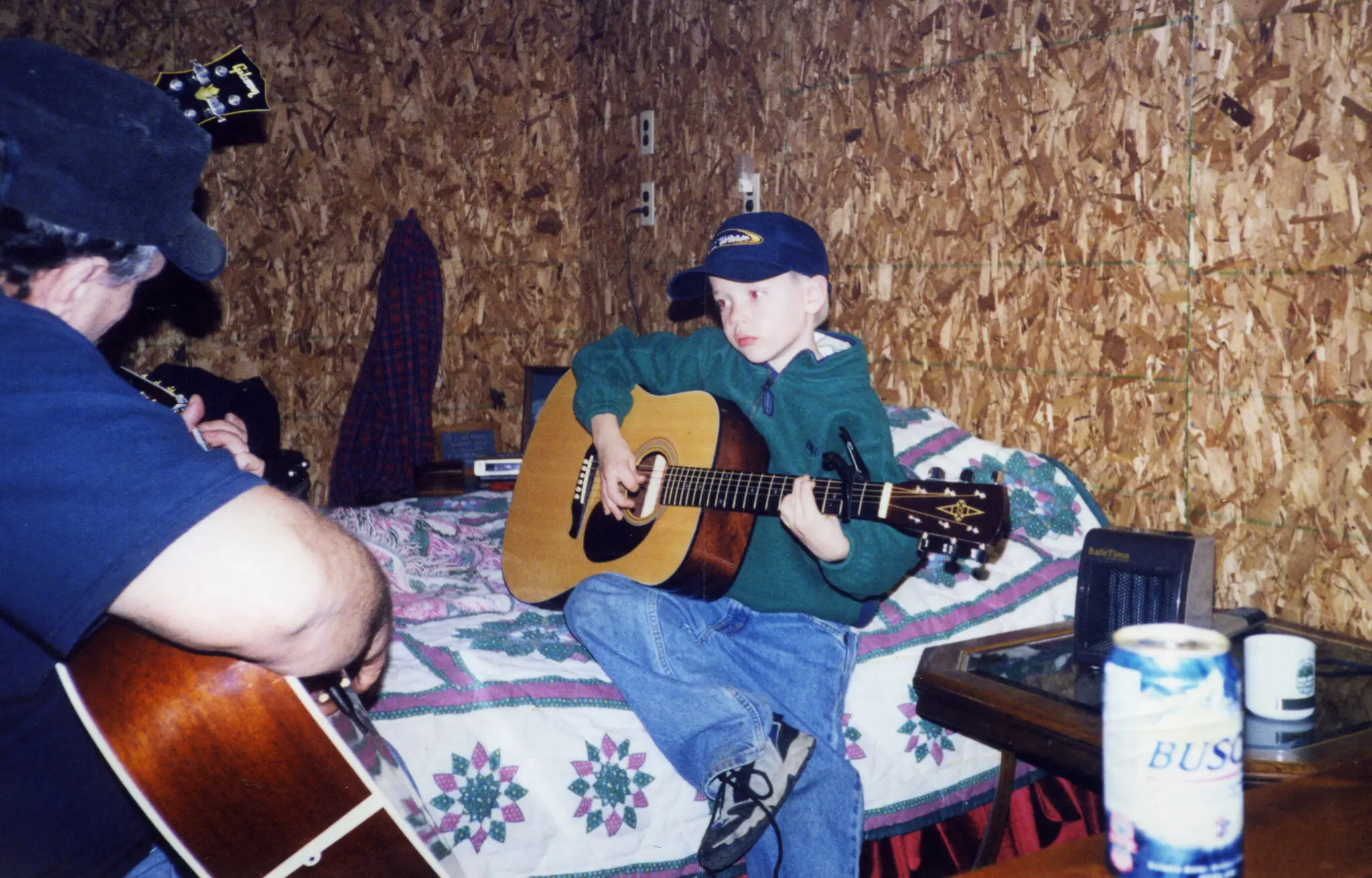 Біллі Стрінгс зі своїм вітчимом, Террі Барбером, наприкінці 90-х — Від Біллі Стрінгса
The album cover itself comes from her. Debra liked to collect discarded objects, scraps and trinkets and turn them into mixed-media art. The piece chosen for the cover was the work she was making near the end of her life — one of the last things she touched.
On the song Still I Crash, Strings is essentially speaking to his mother after her death. It is not an attempt to turn grief into something neat or beautiful. At its center is the bewilderment of someone asking where a loved one has gone and how to learn to live again without her.
He speaks about his mother with the same complexity. She was artistic, vivid and emotionally alive, but she also spent years struggling with addiction and unresolved trauma. For her son, those realities were never separate. Love and destruction existed inside the same family.
Strings’s biological father died of an overdose when he was 2. The man he calls his father is Terry Barber, his stepfather, who taught him the practical details of childhood and, most importantly, put a guitar in his hands.
Strings began playing at around 4. By 6 or 7, he was keeping rhythm while Barber handled the more difficult lead parts. Music was not yet a profession or an escape route. It was the language of home, before the home itself began to fall apart.
His earliest memories remain warm: songs, friends, Beatles records, nights spent with a guitar. Then Barber lost his job, money became scarce and his parents’ addictions deepened. At 13, Strings left home, hoping the shock might force them to change.
 Билли Стрингс — Філіп Монтгомері
It did not. He suddenly realized that he was, for practical purposes, homeless. Yet instead of cutting himself off from his family, he moved closer to the very world that had already taken so much from him. Teenage parties gradually merged with his parents’ way of life.
At 16, he smoked methamphetamine with his mother for the first time. Around the same period he experimented with cocaine, stimulants and crack. Later, he tried heroin partly out of a painful need to understand what could have been powerful enough to matter more to his biological father than his own child.
That period could easily have become the beginning of a different life. But Strings had seen addiction too closely to romanticize it. He was surrounded by people whose lives narrowed to the pursuit of the next dose. He understood where the road led before he had gone too far down it himself.
Music became his primary survival mechanism. Bluegrass returned him to the part of childhood that still contained safety, his father’s guitar and a sense of belonging. Songwriting gave him another route — a way to turn trauma into form rather than allowing it to remain only pain.
His professional career began almost accidentally. Strings worked at a hotel in Traverse City, played coffeehouses, pubs and restaurants, and already considered it a victory when he could finally quit his day job and make a living from music.
Then the scale changed quickly. His debut album, Turmoil & Tinfoil, drew far more attention than he expected. The venues grew larger, and a Deadhead-like culture formed around his tours, with some fans following him from city to city.
 Билли Стрингс — Філіп Монтгомері
Strings traces much of that growth to the moment he stopped trying to look like a “proper” bluegrass musician. Instead of treating the genre as historical reenactment, he let in everything he actually loved: jazz, hip-hop, classic rock, heavy metal, hardcore and long-form improvisation.
The result is an unusually broad audience. Traditional bluegrass listeners can stand beside teenagers, metal fans and people drawn to the free-flowing culture of the Grateful Dead. Strings did not modernize bluegrass cosmetically. He stopped treating it like a museum piece.
But as the success grew, so did the fear of losing it. Before shows, he still experiences intense anxiety, sometimes so severe that he feels close to passing out. After the first few songs, that fear turns into energy and almost aggressive confidence.
Behind that swing is an old internal rule: he has to keep getting better or everything might disappear. Somewhere in his mind is another possible Billy Strings — broke, addicted, living in a trailer and watching life pass by.
That is why performing carries an almost physical sense of survival for him. Each concert is more than a job. It is proof that he is still moving in the opposite direction from the family pattern he inherited.
The birth of his son changed that motivation. Strings has said that he once put so much pressure on himself that he could squeeze the life out of the music. Now the center of gravity is his family. If they are safe, performing no longer has to prove his worth. It becomes the work of a man providing for the people he loves.
 Виступ струнних гуртів на арені Enmarket у Саванні, штат Джорджія, у квітні — Джессі Фаатц
That matters because of where he came from. Strings has been sober from alcohol for a decade, and he speaks openly about drawing a line through his own family history: the generational trauma has to stop with him.
He does not claim that the past can be rewritten. If anything, one of the hardest lessons of his mother’s death is the recognition that love alone cannot force another person to change. Recovery requires the person inside the addiction to want it.
There is a sober clarity in that conclusion. Strings could not save his parents, and he could not give his mother the peaceful old age he had imagined for her. But he can decide what his own son will inherit.
That may ultimately matter more than sold-out arenas or his reputation as one of the most gifted guitarists of his generation. For a boy who once thought a good life meant having food in the cupboard, a roof overhead and avoiding addiction, his success has already gone far beyond anything he expected.
Yet his real ambition remains simpler. Play. Stay sober. Support his family. Do not go back.
In the end, that is where Billy Strings’s virtuosity comes from. Music was never merely a way to escape his past. It became a way to make sure the past ends with him.
Тетяна Федорів — Кореспондент, яка спеціалізується на політиці, економіці та технологіях, проживає у Вашингтоні, США, та висвітлює міжнародні новини.
Олена Лисенко — Головний кореспонден, який спеціалізується на суспільно важливих темах, пише політику, технології та мистецтво. Вона проживає та працює в Україні.
Сименич Вікторія — Кореспонден, який спеціалізується на міжнародній політиці, економіці, науці, технологіях. Вона є дипломатичним кореспондентом в Торонто, Канада.
Повторний випуск публікації 22.08.2026, 22:20 GMT+3 Kyiv; 15:20 GMT-4 Washington.
Цей матеріал опубліковано 09.08.2026, 14:05 GMT+3 Kyiv; 07:05 GMT-4 Washington, розділ: Музика, Інтерв’ю, Аналітика, із заголовком: "Billy Strings Is Playing So He Never Has to Go Back". Якщо в публікації з'являться зміни, про це буде зазначено та описано у кінці публікації.
Читайте щоденну газету та загальну стрічку новин газети Дейком.
Новини, які можуть Вас зацікавити:
Штатні та позаштатні журналісти газети «Дейком» щодня готують сотні публікацій, щоб читачі отримували найоперативнішу, перевірену й глибоку інформацію. Ми працюємо для тих, хто хоче розуміти суть подій, бачити широку картину та бути на крок попереду.